DLP Email Security: Data Loss Prevention
Cybersecurity strategy is only complete with outbound data loss prevention (DLP) technology deployed within the enterprise, cloud, and shared platform environments to protect against data breaches, insider threats, and intellectual property theft.
Request a Demo Today
Watch The Video
Understanding DLP Email Security
DLP entered mainstream information technology (IT) around 2006 when Symantec acquiredVontu. Vontu's solution portfolio focuses on the ability to stop data breaches from happening at the endpoint and a gateway level. While the technology aligns well with security managers and IT directors, enabling policies creates more challenges for the user and customer community, including accidental blocking on critical applications.
DLP Became Critical for Healthcare Providers
“With the inception of the Health Insurance Portability and Accountability Act (HIPAA) Act of 1996, the idea of protecting medical data became important.”
However, it was not until 2010 that hospitals and medical providers modernized by adopting electronic medical records (EMR) with Citrix XenApp and extending the ability to employees to use email and portals to communicate with patients, insurance companies, and third-party labs.
This functionality exposed medical providers to human error, as people started sending sensitive medical information through email without encryption by mistake. These actions led to countless lawsuits and HIPAA violations.
How Important is Email Data Loss Prevention?
Like Vontu in 2006, enabling and managing Email DLP also became a challenge for organizations to help and recognize the value and benefits. Burdened by the operational overhead of DLP, many organizations either abandoned the deployment or scaled back. As compliance requirements, including HIPAA, began to mandate DLP, organizations focused on newer solutions with better ease-of-use deployment models and less operations overhead.
Email communications DLP became a high priority for all regulated industries, including healthcare, finance, government, higher education, research institutes, and defense. D
Newer DLP solutions use policies and rules and pattern-matching things like credit card information, medical record ID numbers, social security numbers, and financial records. DLP's ability to scan all outbound messages for possible compliance violations became a valuable security service.
Accidental data loss, outgoing emails departing the organization without encryption, and sensitive content becoming exposed to the wrong parties all compelled the cybersecurity industry to develop new products and services to reduce email data loss incidents.
As more security incidents rose along with costly fines, email security providers like Trustifi developed their offerings.
Identifying sensitive data
One of the principal business and technical components of DLP is identifying sensitive data. By leveraging built-in templates, rules, and security policies, Trustifi's one-click-to-comply solution helps organizations enable DLP quickly and without disruption to the users. For example, embedded within Trustifi's solution are several pre-configured compliance templates, including CCPA, GDPR, HIPAA, PCI-DSS, and POPIA.
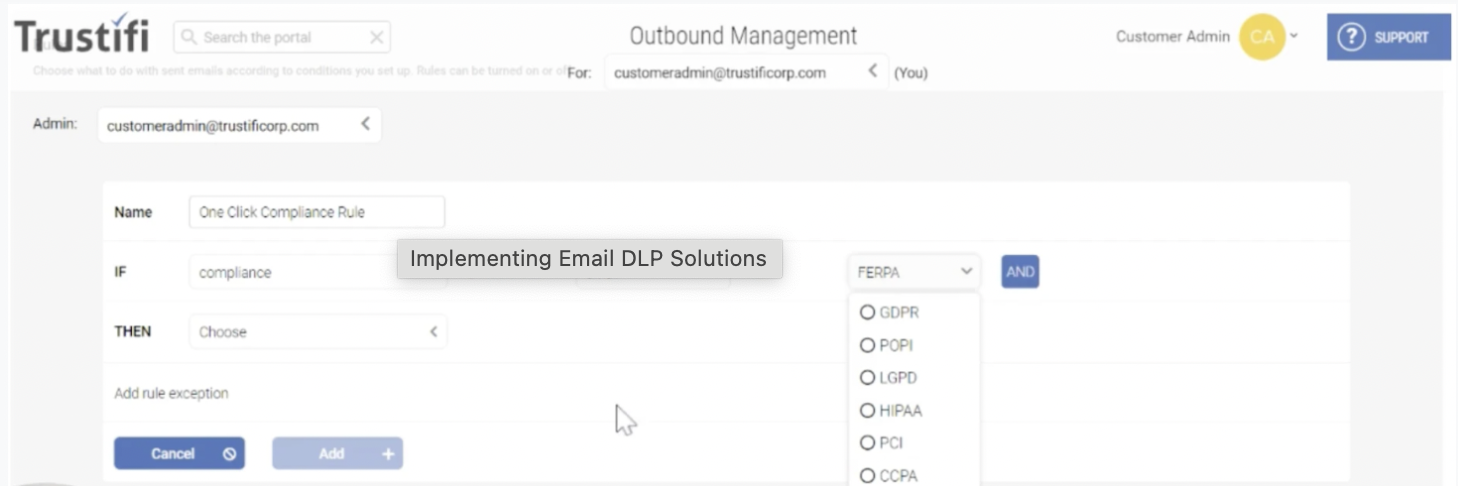
These pre-configured policies help the organization meet regulatory compliance mandates and help identify medical records, credit cards, and other sensitive data before the message becoming released to the recipient.
Reducing Human Error
According to a report published by MIT, 95% of all security breaches resulted from human error. Human errors plagued the initial policy and rule configuration of legacy DLP solutions. Additionally, keeping DLP policies updated over time presented constant challenges.
Even after receiving vendor training and spending money with DLP consultants, security teams still faced challenges with misconfiguration, even with regular expression policies, deep content analysis rules, and policy matches to help stop potential data leaks.
With failures from human error in configurations, organizations allow credit card details and business-critical data to be lean. Accidental data leaks compelled organizations to continue to sustain their current DLP option or look for managed services providers to take over the platform's management.
Organizations facing compliance mandates needed more choice but to either make DLP work or face countless fines for failing to meet regulatory requirements.
What Compliance Mandates Require DLP?
DLP solutions continue to require organizations to meet their various compliance audits, mandates from cyber insurance carriers, and protection requirements mandated by their clients.
HIPAA
HIPAA requires all emails with healthcare and PII information to be encrypted. Email DLP solutions like Trustifi merges their DLP capability with their ease-of-use email encryption solution. Trustifi allows organizations to either allow the end user to click and encrypt within Outlook or Gmail or have a system-wide policy to securely encrypt any message that matches HIPAA outbound policies. This loss prevention strategy helps medical providers meet HIPAA compliance regulations and other compliance mandates.
GDPR
DLP is exceptionally important to EU member states and any global organization collecting the personal information of European citizens. Violating GDPR privacy mandates leads to heavy fines and possible suspension of business operations within the EU. Trustifi DLP helps scan all outbound email messages looking for personal information and extends the ability for organizations to prevent the message from leaving the email systems.
GDPR also requires organizations to notify anyone within 72 hours of a data breach of personal information. DLP capabilities looking into sensitive emails can help prevent breaches requiring this notification.
NIS2
Embedded within the NIS2 framework is the requirement for all EU member states to prevent data. DLP is a vital component in helping organizations scan all outbound messages for specific file types, unencrypted databases, and content within cloud repositories. Classification labels, including confidential, secret, and top-secret, also become detected within a DLP solution. Organizations within the EU need email DLP solutions that allow them to look for labels. Once these labels are detected, email DLP can pass the message forward, encrypt, or block.
PCI-DSS
Deploying is not an actual requirement of PCI-DSS. However, organizations accepting credit cards need to have proper security capabilities to protect this information. DLP provides the tools to help retailers meet DLP, including:
- Monitoring of all outbound data leaving the email change, including credit card data.
- Provide the ability to encrypt credit card information left through emails.
- Provide reports of successful encryption of sensitive data
- Provide the ability to filter suspicious behavior, including hackers attempting a data exfiltration.
What is the Importance of Optical Character Recognition Technology and DLP?
Stopping data loss embedded within image files, including JPEG and PDF files, is also a challenge for all organizations. Most email attachments contain either images or PDF files. Sensitive data embedded within these specific files also needs to be scanned, encrypted, or prevented from leaving the organization.
Optical Character Recognition (OCR) is a valuable capability that needs to be part of any email DLP solution. OCR scans outbound messages and focuses on content within images and attachments, specifically PDF files, looking for unprotected sensitive information. Based on the scan, OCR policies with Trustifi's DLP engine will encrypt the entire message, including the image files and attachments.
While this capability is not perfect, it does work well for clients in the healthcare, financial, and government sectors who frequently send out emails with attachments bearing specific labels requiring encryption to be applied.
Future Trends With DLP
According to data provided by Statista, "The averagecostof a data breach in the United States amounted to 9.36 million U.S. dollars, down from 9.48 million U.S. dollars in the previous year. The global average cost per data breach was 4.88 million U.S. dollars in 2024."
As the cost of breaches rises, cybersecurity tools require continuous innovation to meet the next-generation challenges across the global threat landscapes. Hackers continue to advance their capabilities, including greater adoption of adversarial AI and ML tools, creating more havoc for organizations charged with protecting sensitive information.
DLP security solutions will continue incorporating AI and ML capabilities to help learn from previous outbound malicious behaviors. This valuable telemetry information helps cybersecurity vendors improve their solutions to help their clients reduce security risks, improve threat detection, and automate the incident response capability.
Security tools without any form of AI will cease to exist in the coming years. AL-enabled cyberattacks will bypass legacy security measures, resulting in more suspicious activities becoming actual exploits.
Why Trustifi?
Trustifi's global success in adopting AI within its inbound shield solution continues to win industry recognition and new clients. The company extended its expertise in AI and incorporated this functionally across DLP, security awareness, and attack simulation.
Outbound DLP powered by AI transcends Trustifi's unified email security platform to another rarely matched by their competitors. Extending the ability for their clients to leverage AI to scan outbound messages, similar to the same capability found within their inbound shield, gains total email protection, operational efficiency, and invaluable insight.
Case Study
Client: Northeastern Rural Health Clinic (NRHC)
Location: Susanville, CA
Challenge:
NRHC previously deployed ZIX and Microsoft to help provide email encryption solutions integrated into their messaging workflow to begin the transformation from legacy fax machines to secure email.
- The cost to maintain the solution was more expensive than initially budgeted.
- When defining policies and rules, the console is prone to human error.
- It is challenging for end-users to encrypt and decrypt messages from patients and external doctors.
Solution:
Trustifi Exceeding NRHC’s Expectations! Inbound email protection, including antispam, anti-malware, and domain spoofing Outbound Email Protection, including Email Encryption and Data Loss Prevention. Easy-to-use management console Email Archiving Executive Notification and HIPAA Compliance Reporting Quick ramp-up and end-user adoption.
Quote:
“My team is 100% responsible for all the data at rest or in transit, as well as any HIPAA or PII data. Our organization needs a secure, affordable, easy-to-use email encryption solution. Trustifi delivered!”
“Jacobb Sullens Information systems manager, NRHC”
Who is Trustifi For?
Trustifi offers an all-in-one platform that is a perfect fit for small and mid-size businesses. We provide the enterprise-grade protection you need without the enterprise-level complexity.
- Small and Mid-Size Enterprises (SMEs): Protect your intellectual property and customer data with an affordable, easy-to-use solution that requires zero technical expertise to manage.
- Managed Service Providers (MSPs): Easily deploy, manage, and monitor email security across multiple client environments from a single, multi-tenant console. Keep your clients happy and their data secure.
- Regulated Industries: Ideal for healthcare, finance, and legal teams that must adhere to strict data privacy laws like HIPAA, PCI-DSS, GDPR, and FERPA.
Platform Specifications & Integrations
|
Encryption Standard |
AES 256-bit End-to-End Encryption |
|
Native Integrations |
Microsoft Office 365, Google Workspace, On-Premise Exchange |
|
Supported Compliance Frameworks |
HIPAA, PCI-DSS, GDPR, CCPA, FERPA, POPIA, PDPO, NIST 800-53 |
|
Advanced Scanning |
AI-powered Optical Character Recognition (OCR), Lexicon Matching, Behavioral Analytics |
|
File Size Limit |
Securely encrypt and send attachments up to 1GB |
Frequently Asked Questions
How does Trustifi’s Data Loss Prevention work?
Our DLP system uses an intelligent AI engine to scan your outgoing emails and attachments in real-time. If it detects sensitive information like personal data or financial records, it automatically encrypts the email before it leaves your outbox.
Do my recipients need to create an account to read my encrypted emails?
No. We make secure communication simple. Your recipients can open encrypted emails with a single click, without ever needing to register for an account or log into a third-party portal.
Is Trustifi a good fit for Managed Service Providers (MSPs)?
Absolutely. Trustifi is designed with MSPs in mind, offering a seamless, multi-tenant dashboard that makes it easy to provision, manage, and bill for small and mid-size enterprise clients.
Does Trustifi protect against inbound threats as well?
Yes. We offer a comprehensive, all-in-one solution. While our outbound DLP keeps your sensitive data from leaving, our inbound shield proactively blocks phishing, malware, and ransomware from entering your network.