Quishing Attacks
Keep your organization safe from targeted threats with powerful multi-layered scanning technology. Deeply analyze, detect, and classify the most advanced Phishing, Malicious, SPAM and even Gray emails.



Quishing Attacks: How to Stop QR Code Phishing Security Threats?
Digital QR Codes and quishing attacks continue to escalate through artificial intelligence (AI) generated, well-crafted phishing emails by embedding common malicious snippets within the code images. QR code and quishing have become a new cybersecurity threat, combining social engineering with email phishing. This combined attack vector accounts for an incredible rise in ransomware and other security risks, becoming a challenge to protect user devices.
Trustifi, a leader in advanced cybersecurity AI-email software products and 24x7 support, leveraged its security operation (SecOps) teams to help monitor and protect against the latest phishing attacks targeting its clients. In 2023, the Trustifi SecOps services team tracked and collected information in their report showing signs of a 250% increase in QR codes fueling quishing attacks from July to September alone.
Hackers found a way to install a rogue QR code to access their victim's credentials and personal data on their devices and embed malware. The potential for this threat vector to become an even bigger global problem is very real.
Why is Quishing a Threat To Every Industry?
The FBI reported in September 2023 that threat actors continue to plant (QR) in several public areas, encouraging users to scan, becoming the next victim of phishing link exploits.


QR code phishing attacks are a newer web threat that has been increasing in prevalence because users trust them.
Legitimate businesses, especially those handling financial information and processing transactions, movie tickets, sporting events, and airlines, will use a QR code for credential login and proof of purchase. Hackers and scammers will pose as a type of lookalike travel site and create a QR code attack to harvest credentials and access their victims' value data.

Scammers use a new method, quishing methods based on QR codes, to access user account data in multiple ways. First, the rogue QR code helps them avoid detecting and blocking emails even after being scanned for malware embedded within the image or message. The ability to check digital QR codes for content is complex because most messages have little information, text, or traditional phishing content.
Since the messages have no link to web services, scammers don't need to create additional accounts or domain information on the device to redirect users and hide phishing attempts. To add complexity, organizations use QR codes for legitimate social and security technical reasons, including inserting the sender's automatic signature. This attack vector increases the risk of retailers and others using a QR code for product delivery.
Most users quickly scan various QR codes on smartphones. However, they may overlook the rogue web address line of the redirected page on a mobile software browser, which could be more noticeable.
- Email phishing escalates through QR code exploits to unsuspecting users and their device. These AI-generated, well-crafted messages embedded with a code image can cause credential harvesting links, personal information leaks, data theft, and identity theft.
- The quishing security attack capability is rising because the attackers discovered that a business using security solutions doesn’t scan the QR code in emails or information files or follow the redirect link to the final website.
- Preventing any cyberattack, including email phishing, social engineering, ransomware, information theft, and quishing, requires the enablement of several protection capabilities fully integrated into a single platform to stop a rouge QR code from infecting devices.
Attempting to stop cyberattacks, including quishing and phishing, using a standalone device with traditional business email security protection will result in exploits, data exfiltration, login credentials theft, and loss of productivity within the organization.
Trustifi AI Phishing Detection Security Software: Built to Stop Quishing.
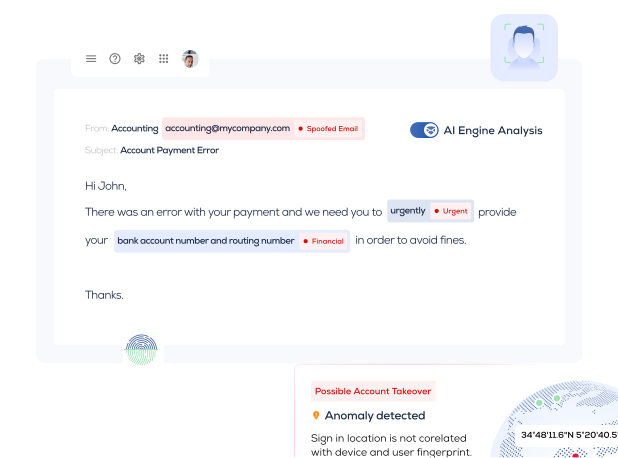
Trustifi's advanced AI services and support capabilities effectively stop a quishing attack while leveraging proprietary metrics to detect, protect, and quarantine malicious emails, URLs, and files that aim to steal the recipient’s valuable and sensitive information off their device.
-
OCR Scanning and QR Code Detection.
Trustifi extends free OCR scanning for QR codes embedded with their award-winning Inbound shield module. Individuals and security engineers can access the OCR setting from Trustifi’s unified management console.
The OCR scanning services inspect the QR code object, looking for embedded URLs and other rogue-related information already examined by Trustifi AI filtering engines.
Fact: Legacy email security services and solutions, including secure email gateways, rarely include OCR scans in their security measures.
-
AI-Enabled Inbound Filtering Engine Against Quishing.
AI-enabled email security solutions like Trustifi have several advanced security filters, including anti-evasion, embedded URL analysis, and the ability to stop access and impersonation attempts from the first email phishing attack.
-
Malicious Email Attachment Detection and Prevention.
Trustifi's advanced AI-enabled inbound shield will scan every attachment, looking for key indicators of a QR code attack:
- Does the QR Code URL code contain HTTP or HTTPS, prompting the business user for a username and password on their device?
- Is the QR code URL domain legitimate or misspelled?
- Is the QR code redirecting the employee to a known phishing site?
- Is the QR code attempting to download malicious malware on their device after the employee presses the image?
Trustifi's powerful security AI-filtering engine will check, scan, and detect these phishing and quishing malicious methods, preventing a breached QR code by blocking access and stopping them from performing threats against its client's devices. Trustifi's AI engines learn over time as more of these types of QR codes morph into new threat vectors. This learning process is the key to Trustifi's continuous success in stopping AI-enabled hacker attacks.
Moving Beyond Just Detection Quishing, Powered by Trustifi Email Security.
Quishing and phishing email threats powered by hacker AI services will not disappear soon. However, organizations that want to fight "fire with fire" will consider migrating, consolidating, and optimizing their email security, leveraging data loss prevention, email encryption, and compliance information reporting strategy used by Trustifi customers.
With its market-leading AI filters, domain authentication, and message encryption, Trustifi simplifies email security while delivering exceptional security protection against phishing and quishing through its consolidated cloud-based platform.
Stopping next-generation AI-enabled phishing and quishing threats is at the core of Trustifi's expertise with its email security products. The company's early adoption of AI and machine learning continues to lead the market with greater email protection efficiency and more automated incident response against rogue QR codes.

Organizations looking to replace their cybersecurity legacy security products should look into cloud-based platforms from Trustifi, powered by AI, for protection against quishing and phishing by cyber criminals redirecting indivduals to shady websites, harmful attachments, and scam websites. All from a single management console.
Simple, easy, and affordable with excellent global support. Clients trust Trustifi.