Preventing email attacks starts with investing in the correct cybersecurity prevention strategy. Relying on legacy email security tools, outdated hosted services, or standalone devices will not prevent next-generation email attacks from stealing your data.

Are you interested in seeing this platform in action? Click here to schedule a demo!
Overview of Email Attack Types.
The primary attack vector within any email attack continues to be phishing, which spawns other attack vectors, such as malicious links, malware content, simple text attacks, and rogue attachments.
Cybercriminals pretend to be someone trustworthy through email or social media to steal information like login details. They send fake emails to trick people into sharing personal or financial information or downloading malware.
Ransomware, account takeover, identity theft, impersonation attacks, and business email compromise originate from an initial phishing message.
However, phishing is not the only core attack. Hackers continue to exploit their victims through voicemail, SMS texting, social engineering, and even physical contact.
Detailed Analysis of Common Attacks.
Common email attacks start with a strategy to trick and deceive their clients. Some attacks are a single email; others become part of a kill chain incorporating several attack methods.

Business Email Compromise.
“BEC attacks involve attackers posing as key employees, often high-level executives, to send targeted emails requesting financial transactions, particularly in the finance department. These attacks use social engineering tactics to manipulate victims into complying with the fraudulent requests.”
According to the latest FBI report, Business Email Compromise (BEC) is a serious issue, causing over $2.7 billion in losses. Learn about available BEC protection tools to stop these attacks. Whaling phishing plays a significant role in BECs.
Recently, researchers found two groups using executive impersonation in attacks in 13 languages. Automated tools, like Google Translate, make it easier for cybercriminals to target victims worldwide. BECs are a global problem, not just in English.
Malware Attacks.
Ransomware is a specific type of malware, and rootkits, Trojan Horses, and keyloggers are examples of malware executable attacks.
Man-in-the-Middle (MitM).
MitM attacks happen when a hacker intercepts and changes email conversations without anyone’s knowledge. This allows them to steal information, change emails, or send them to the wrong person. To help prevent this attack, email encryption is recommended for all organizations, regardless of sector or industry.
Account Takeover.
ATO attacks occur when cybercriminals gain unauthorized access to a user’s email account, allowing them to send fake emails, view sensitive information, and carry out additional attacks.
Whaling Phishing.
“Whaling is a phishing attack that targets high-profile individuals, including the CEO, COO, and CFO.” Hackers will send emails that appear to be from top executives requesting money transfers or sensitive information. This attack can be very profitable for the attacker, as they can steal large amounts of money or valuable data.
Pharming Phishing.
Pharming is a cyber fraud tactic that tricks people into entering information on a fake site. There are two methods of pharming. First, malware infecting host files redirects users to malicious sites without their knowledge. Second, DNS poisoning uses email spoofing, leading users to fake websites and stealing personal information.
Clone Phishing.
Clone phishing is an attack method that uses previously sent email content disguised as a new malicious message.
Clone emails often take previously sent legitimate emails and copy them verbatim. The sender’s tone may have been more professional, detailed, oriented, and open to assistance in the original email message than the malicious version. Clone phishing emails tend to show a tone with a sense of urgency and usually have grammatical errors. A changed tone within the email should indicate that this is not a legitimate sender, so it might be fake.
Spear Phishing.
Spear phishing is a targeted technique in which personalized emails impersonate a trusted source. This tactic increases the chances of the victim being deceived because the attacker researched the victim using social media, making the email appear more legitimate.
Vishing.
Vishing is a scam that exploits people’s trust in the telephone network. Hackers use VOIP services like Vonage to make calls to their victims, and these numbers take time to trace. Victims of vishing may receive threatening recorded messages claiming to be from government agencies or banks. The hackers try to trick victims into giving up sensitive information like account details and social security numbers.
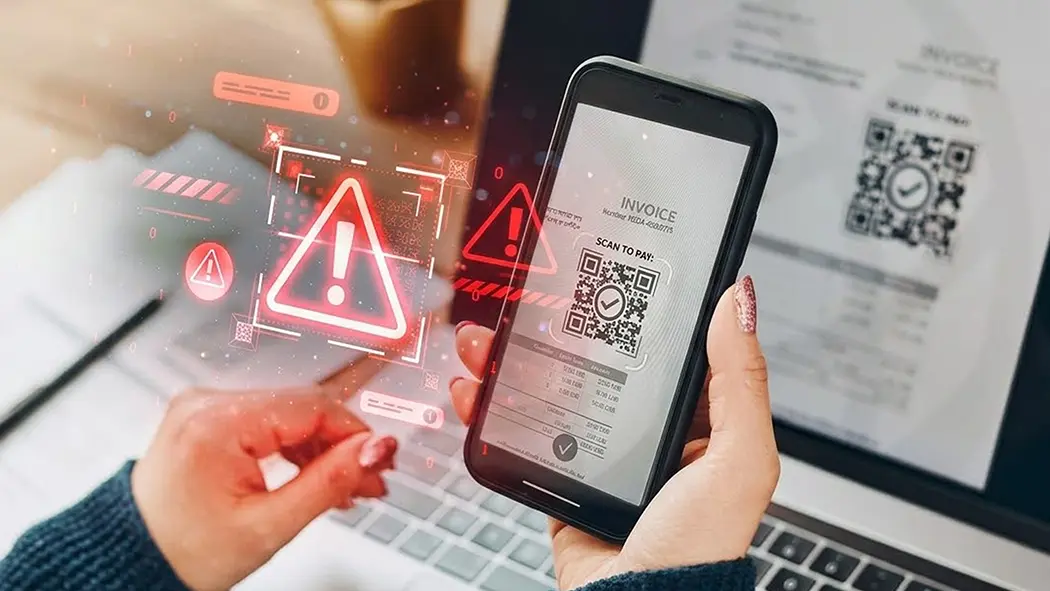
QR Code Phishing.
QR code phishing, also known as a quishing attack, is a newer form of this type of attack that has been increasing in prevalence.
Legitimate businesses, especially ones that handle financial transactions, movie tickets, sporting events, and airlines, will use QR codes requiring a credential login. Hackers and scammers will pose as a lookalike travel site and use the QR code attack to harvest credentials.
Scammers benefit from using QR codes in multiple ways. First, the rogue QR codes help them avoid detection and blocking of emails, even with malware embedded within the image or message. Checking QR code content is complex because most messages have no text or phishing links.
Real-World Examples of Email Phishing Attacks in 2023 and 2024.
Email phishing, ransomware, and deepfake will continue to affect users and global organizations in 2023 and 2024. Here are global statistics showing how impactful phishing attacks have become.
- “According to data from 2023, Vietnam had the highest phishing attack rate among internet users at 18.91 percent. Peru and Taiwan also experienced high attack rates, with Peru at nearly 17 percent and Taiwan at 15.59 percent.”
- “In early 2024, over 963,000 phishing sites were detected globally, slightly down from the previous quarter. The biggest increase in phishing sites occurred between the second and third quarters of 2020.”
- “In the first quarter of 2024, phishing attacks worldwide targeted social media, web-based software services, and webmail the most, followed by financial institutions.”
What Are The Most Common Mechanics of Email Attacks?
Most email attacks start with some level of deception. This deception could be an impersonation of a CEO from an ecosystem partner or a CFO from your organization approving a very questionable invoice, or it could be a well-crafted email with a fake domain, altered logo, or actual authentic content from a previous highjacked message.

These tools provide exceptional mechanics for hackers to gain the ability to adjust their attack vectors, the geolocation of the attack, and the velocity.
Impact of Email Attacks in 2024 Statistics.
“In the first quarter of 2024, Microsoft remained the most imitated brand in phishing attacks, comprising 38% of all phishing attempts. Google moved up to the second spot with 11% of attempted brand phishing attacks, while LinkedIn also saw an increase to third place with 11% of such attempts compared to the previous quarter.”
“At 16%, phishing was the second most common reason for data breaches and the costliest, averaging $4.91 million in breach costs. One of the most expensive phishing attacks was through compromised emails with around 19,369 complaints and a loss of $1.8 billion.”
“Statistics on phishing emails show that approximately 1.2% of emails are malicious, resulting in about 3.4 billion phishing emails daily.” Over 33 million records are projected to be extorted by 2023, with a ransomware or phishing attack happening every 11 seconds.
Future Trends in Email Security.
The future of email security changes far more rapidly than in previous years. Adopting Natural Language Processing (NLP) and generative AI tools will continue to make the detection and prevention of BEC attacks, domain spoofing, and identity theft attacks challenging.

What Preventive Email Security Measures Are Available?
Organizations facing financial losses because of email attacks must evaluate their current email security strategy. As more AI and ML tools develop, hackers will continue to move far more rapidly in creating attack vectors, and there is now a need to invest in advanced AI email security.
Trustifi, a global leader in advanced email powered by AI and ML, understands the criticality of protecting its clients’ data. Its market-leading platform delivers several protection layers fully integrated into a single console to stop inbound and outbound email attacks.
These layers include:
- Inbound shield powered by AI and ML blocks next-generation email attacks and stops domain spoofing and account takeover.
- Outbound Shield delivers a potent combination of email encryption, data loss prevention, and tokenization.
- Email security awareness training and attack simulation powered by AI leveraging actual attack telemetry captured from Trustifi ThreatOps teams help keep users informed while improving the organization’s readiness.
Conclusion
Cybercriminals frequently adapt their tactics, compelling organizations to adopt a proactive approach to email security. Explore the upcoming email security trends in 2024 to stay informed and protect your digital communication.
Clients in regulated industries, including healthcare, finance, and government, benefit from Trustifi’s fully integrated email threat scanner, email archiving, e-discovery, and data retention solution offering. Organizations required to capture and keep email communications, including applying legal hold policies, can use the Trustifi management console.
Get Started With Trustifi Today – Easy, Affordable, and Comprehensive
Whether you are looking for an extra layer of protection in your existing email environment or a full-suite solution, the expertise and simplicity Trustifi offers will exceed your expectations. Let’s discuss pricing and a customized email security plan for you.