Business email compromise is a targeted, deception-based attack where criminals impersonate a trusted person or organization to steal money, credentials, or private data. While many BEC messages rely purely on social engineering with no malicious payload, some campaigns do include weaponized links or attachments, which means defenses need to account for both approaches.
According to the FBI’s Internet Crime Complaint Center (IC3), business email compromise (BEC) scams account for
over $3 billion in annual losses, making it one of the most financially damaging categories of cybercrime. This article covers the layered controls organizations need to prevent BEC, explains why this threat is hard to catch, walks through what to evaluate when choosing a protection platform, and shows how Trustifi brings AI-powered inbound and outbound email security together in one place.
The strongest BEC defenses combine email authentication protocols, AI-powered email security like Trustifi’s Inbound Shield, phishing-resistant multi-factor authentication, payment verification procedures, continuous monitoring, and attack simulation training.
The Core Layers of a Strong BEC Defense
No single tool stops business email compromise on its own. Attackers adapt fast, and BEC schemes rely on human trust as much as technical gaps, so a successful defense means layering controls that reinforce each other.
Below, we cover seven categories that work together: email authentication protocols that block spoofing at the infrastructure level, AI-powered email security led by Trustifi, identity protection through phishing-resistant multi-factor authentication, payment and process verification controls, continuous security monitoring, employee-facing attack simulations, and outbound protections including encryption and data loss prevention.
Trustifi anchors the email security layer because BEC attacks often begin at the inbox, where a spoofed or impersonated message either gets caught or gets through.
Email Authentication
Before any message reaches an inbox filter, email authentication protocols serve as the first structural barrier against domain spoofing, one of the most common BEC tactics.
SPF (Sender Policy Framework) lets domain owners publish a list of servers authorized to send mail on their behalf. When a receiving server gets a message, it checks whether the sending IP matches the domain’s SPF record. Messages from unauthorized sources can be flagged or rejected.
DKIM (DomainKeys Identified Mail) attaches a cryptographic signature to outgoing messages, allowing the receiving server to verify that the message was not altered in transit and that it originated from an authorized sender.
DMARC (Domain-based Message Authentication, Reporting and Conformance) ties SPF and DKIM together with a policy that tells receiving servers what to do when authentication fails: monitor, quarantine, or reject.
While a monitor-only policy provides visibility without stopping spoofed messages, enforcing a quarantine or reject policy actively prevents unauthenticated mail from reaching end users. DMARC also generates reporting data that gives domain owners visibility into who is sending mail using their domain.
Together, these three protocols make it significantly harder for attackers to spoof your exact domain in outbound-facing attacks. However, they do not prevent lookalike domain registration (e.g., “companny.com” instead of “company.com”), compromised account abuse, or attacks sent from free email providers impersonating executives by display name alone. That is where AI-powered email security fills the gap.
Trustifi’s Inbound Shield
BEC attacks succeed when a malicious email reaches an inbox and looks convincing enough to act on. That’s the problem Trustifi’s Inbound Shield is built to solve, using AI-powered detection to
catch phishing attempts, impersonation, and spoofing before an employee sees them.
Inbound Shield analyzes messages in real time, running suspicious attachments through sandbox analysis before delivery and rewriting links so they can be inspected and blocked before a user reaches a malicious site. Sender analysis flags domain spoofing, lookalike domains, and impersonation attempts. These are the same tactics attackers use when posing as executives, finance staff, or vendors.
Anti-spoofing and anti-impersonation controls target the account types attackers exploit in BEC schemes (executive, finance, and vendor mailboxes) because messages from those accounts carry the most financial risk. For IT teams, this means fewer dangerous emails reaching end users without demanding manual review of every flagged message.
Trustifi integrates with Microsoft 365 and Google Workspace, and deployment doesn’t require MX record changes. Administration runs through one console rather than several disconnected tools.
Inbound filtering is a critical layer, but it has limits. An attacker who compromises legitimate credentials can send messages from an authorized account, bypassing message-level controls.
Multi-Factor Authentication
Account takeover is where BEC often causes the most damage. Once an attacker gains access to a valid mailbox, they can send messages that are not just convincing but genuinely come from a trusted account, which is what gets them past employees trained to spot phishing.
Multi-factor authentication adds a verification barrier that makes stolen credentials harder to exploit. Standard MFA methods such as SMS codes or push notifications significantly raise the difficulty for attackers, though sophisticated techniques like real-time phishing proxies and MFA fatigue attacks have been used to bypass them in documented incidents.
Phishing-resistant MFA, such as FIDO2 hardware security keys or passkeys, offers a stronger layer of protection because the authentication is bound to the legitimate site and cannot be intercepted by a proxy or replayed by an attacker.
This matters most for high-value accounts: executive, finance, HR, and vendor-facing mailboxes where a single compromise can authorize a fraudulent wire transfer or redirect a payroll deposit. That said, MFA in any form does not stop a spoofed email sent from an external domain, social engineering that never touches credentials, or attacks originating from a compromised third-party account. It is one essential layer, not a standalone solution.
Payment and Process Verification Controls
The costliest BEC outcomes are fraudulent wire transfers, redirected invoice payments and payroll diversions. They succeed not because technical defenses failed but because internal processes allowed a single email to authorize a financial action.
Dual-approval requirements for wire transfers, vendor payment changes, and payroll modifications are designed so that no single compromised mailbox or deceived employee can complete a high-risk transaction alone.
Out-of-band verification means confirming sensitive requests through a separate communication channel. If a vendor emails new banking details, the accounts payable team calls the vendor using a previously verified phone number, not a number included in the email, to confirm the change.
Documented escalation procedures give employees a clear path to follow when a request feels unusual, even when it appears to come from a senior executive. BEC attacks frequently rely on urgency and authority to short-circuit normal judgment, so having a defined process removes the pressure to act immediately.
Immediate incident response protocols ensure rapid containment if a fraudulent transaction occurs. This includes requesting an immediate wire recall or recall request through the originating bank and submitting an incident report to the FBI’s Internet Crime Complaint Center (IC3) to assist in financial kill-chain efforts.
These procedural controls directly address BEC scenarios that no email filter, authentication protocol, or MFA deployment can fully prevent: a well-crafted message from a compromised vendor account requesting a legitimate-looking payment change.
Regular Security Monitoring
Many BEC attacks succeed because nobody notices the warning signs until the money’s gone. Regular security monitoring closes that gap by watching for unusual sending patterns, login attempts from unexpected locations or devices, abnormal mailbox rule creation, and other deviations from a user’s established behavior.
This is useful for
spotting account-takeover activity, since a compromised mailbox behaves unlike its owner: sending at odd hours, forwarding messages to unfamiliar addresses, or creating rules that hide replies from the account holder.
Trustifi’s Account Takeover Protection covers this layer, profiling each user’s normal login behavior and flagging impossible travel, odd login hours, new devices, and shifts in communication patterns, then alerting administrators and blocking access to a breached account.
Alerts and per-user behavior reporting run through the same console as the rest of the platform. Monitoring catches what filters and access controls miss, but employees are still the last decision point in most BEC attempts.
Realistic Attack Simulations
Many costly BEC incidents happen because someone made a fast decision under pressure, responding to an urgent message from a familiar name rather than pausing to verify.
Realistic attack simulations put employees through the same tactics used in live BEC campaigns: executive impersonation, invoice approval requests, wire transfer urgency, payroll update notifications, and vendor payment confirmations.
Simulation value comes down to three things:
- Realism: scenarios have to mirror the language and context of live attacks.
- Continuity: one-off sessions don’t change behavior; recurring simulations do.
- Measurement: track click rates and reporting rates over time.
Trustifi’s Email Security Awareness Training runs these simulations and tracks those metrics, building results into a continuous training cycle rather than a one-time session.
Training works best paired with technical controls, not in place of them. Inbound filtering reduces how many malicious messages reach employees in the first place, while simulation training sharpens judgment on the ones that do get through.
Encryption and Data Loss Prevention
Trustifi extends protection to outbound email with one-click encryption and real-time data loss prevention. These controls serve a specific and important purpose: reducing the risk of sensitive data leaving the organization through a compromised or misdirected message.
Automatic DLP policies scan outbound email for restricted data patterns, such as banking information, healthcare records, or legal content, and enforce protection without manual intervention.
One-click encryption means that when sensitive messages must be sent, they are protected in transit without requiring recipients to install software or create portal accounts.
An important distinction: encryption and DLP protect confidential information from exposure, but they do not prevent an employee from approving a fraudulent wire transfer or responding to a spoofed invoice with a payment confirmation. The most common BEC financial losses come from authorized actions taken by deceived employees, not from data leaving an inbox unencrypted. That is why payment verification procedures and process controls exist as a separate, essential layer.
Together with inbound filtering, monitoring, and training, outbound protections add a further layer, but they are one part of a defense strategy that must also include procedural safeguards.
Why Business Email Compromise Protection Matters
A successful BEC attack rarely stays contained to one bad transaction. Victims face direct monetary loss, credential theft that opens the door to further compromise, exposure of private customer or employee data, operational disruption during incident response, and reputational damage that can linger long after the incident is resolved.
Here’s how these schemes play out across five common scenarios:
- CEO or executive impersonation: An attacker spoofs or compromises an executive’s account and instructs finance or HR to act at once on a wire transfer, gift card purchase, or data request.
- Invoice and payment redirection fraud: A vendor’s invoice arrives with updated banking details that look routine, but the destination account belongs to the attacker.
- Vendor email compromise: A verified vendor’s account is compromised, letting attackers send authenticated messages requesting payment or data without raising obvious flags.
- Payroll diversion: HR receives what looks like a routine request to update an employee’s direct deposit details, and the change sends that salary to an attacker-controlled account.
- Account takeover-driven internal fraud: An attacker uses stolen credentials to log into a legitimate mailbox and initiate fraudulent requests from within the organization’s own domain.
Instead of relying solely on malware or malicious links, attackers borrow brand identity, register lookalike domains that differ by a single character, operate from compromised accounts, and write messages calibrated to the target’s role and relationships. Some BEC campaigns do include weaponized attachments or credential-harvesting links, particularly in the initial access phase, but the defining characteristic is impersonation and trust exploitation.
The result is a spoofed email that looks authentic to the recipient and to many automated email filters.
The stakes climb higher in regulated industries. Healthcare organizations risk ePHI exposure and HIPAA liability; financial services firms face client fund fraud alongside FINRA and SEC reporting obligations; legal practices risk breaching attorney-client privilege; and government agencies put citizen data and contract integrity at risk.
In any of these environments, one successful BEC incident can trigger breach notification requirements, regulatory investigations, and civil liability on top of the financial hit.
Organizations need protection built for enterprise-level risk but simple enough for administrators and end users to operate without friction.
How Trustifi Handles the Inbox Layer
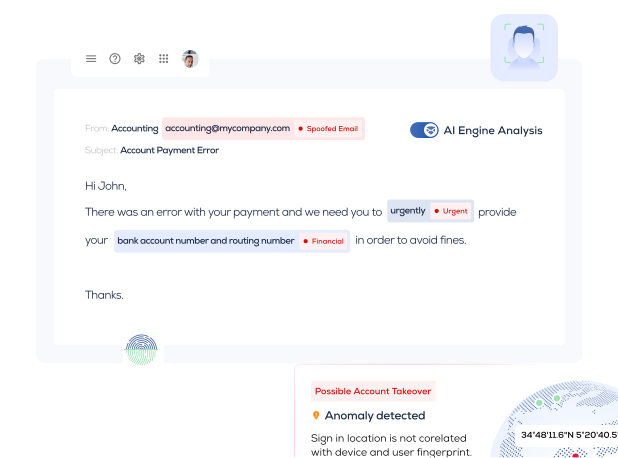 |
Trustifi Inbound Shield targets the inbox stage of a BEC attack, combining multi-layered AI detection with a deployment that requires no MX record changes. It catches sophisticated social engineering and impersonation scams that slip past basic email filters, making it a strong fit for teams using Microsoft 365 and Google Workspace.
How it works: Trustifi sandboxes every inbound message and runs it through deep header analysis, link inspection with zero-day phishing detection, and file scanning that even digs inside archives. Trustifi reports that its platform stops 99% of phishing attacks that other email security solutions miss, including CEO fraud emails and fake invoice requests targeting finance departments.
LEARN MORE |
What to Look for in BEC Protection Tools
The market is full of point solutions that address one slice of the BEC problem. The goal is finding a tool that covers the full attack surface without piling on operational complexity.
There’s a stark difference between checkbox security, which looks good in a vendor comparison sheet, and functional protection that maps to how attackers operate.
Email Authentication and Anti-Spoofing
Confirm that your domain has properly configured SPF, DKIM, and DMARC records with an enforcement policy. Any email security platform you evaluate should complement and build on these foundational controls.
AI-Powered Threat Detection
Look for platforms that use machine learning to identify phishing, impersonation, spoofing, and anomalous behavior, not signature-based filters that attackers have learned to sidestep.
Unified Inbound and Outbound Coverage
BEC attacks don’t just come at you. They also go out through you. Inbound filtering blocks malicious email before it reaches your team. Outbound encryption and DLP help protect sensitive data from exposure through a compromised or misdirected message.
Account Takeover Visibility
The platform should catch behavioral anomalies tied to compromised accounts: odd login locations, erratic sending patterns, and mailbox rule changes that suggest someone else is operating the account.
Native Integration with Existing Email Environments
Deployment shouldn’t require an infrastructure overhaul. Look for solutions that work with Microsoft 365 and Google Workspace without MX record changes.
Low-Friction Encryption
Prioritize one-click encryption that works for senders and recipients without extra software or a portal account.
Built-In Data Loss Prevention
Automatic DLP policies should scan outbound email for restricted data patterns (banking information, healthcare records, legal content) and enforce protection without intervention. Note that DLP prevents sensitive data exposure; it does not block an employee from acting on a fraudulent payment request.
Payment and Process Controls Compatibility
Evaluate whether your BEC defense strategy includes procedural safeguards, dual-approval workflows, out-of-band verification for payment changes, and escalation paths that address the fraud scenarios email filters alone cannot prevent.
Compliance Automation
The platform should support documented controls for HIPAA, GDPR, CCPA, FINRA, and other applicable frameworks, with audit-ready reporting that cuts down manual documentation work.
Centralized Management and Reporting
IT teams and MSPs need one console to configure policies, review alerts, and generate reports across every user or client tenant, rather than switching between separate tools.
Low User Friction
Security controls that slow down routine work tend to get disabled or worked around. Protection should block attacks without employees noticing it during normal email use.
Scalability for Growth and Multi-Tenant Environments
The platform should support growing organizations and MSPs managing multiple clients without per-tenant reconfiguration or performance loss at scale.
The strongest BEC protection tools reduce risk without adding complexity for the IT teams running it and for the employees using email every day.
Strengthen Business Email Compromise Protection with Trustifi
The layered defense described earlier does not have to come from a fragmented stack of disconnected vendors. Many teams end up stitching together an inbound filter, an encryption tool, a DLP product, and a monitoring platform, then absorbing the cost of multiple contracts, multiple consoles, and the blind spots that form between them.
Trustifi runs all of it from one platform and one admin console, deployed without MX record changes, so inbound filtering, encryption, DLP, and account-takeover monitoring are configured and reported on in the same place rather than negotiated between four products.
That consolidation matters differently depending on who’s buying. Mid-market and enterprise IT teams get full inbound and outbound coverage without assembling a custom security stack or staffing it. MSPs and MSSPs get multi-tenant management and a channel-aligned partner rather than a vendor competing for their clients.
Regulated organizations in healthcare, financial services, legal, and government get documented, audit-ready controls for the frameworks they answer to.
See how
Trustifi closes each layer of the BEC attack chain from one console.
Frequently Asked Questions
How does BEC differ from phishing?
Business email compromise is a specific type of phishing that relies primarily on impersonation and social engineering to trick recipients into taking a harmful action, such as authorizing a payment, sharing credentials, or sending sensitive data.
While general phishing campaigns tend to cast a wide net using malicious links or attachments sent to large recipient lists, BEC attacks are usually targeted, well-researched, and tailored to a specific person’s role, relationships, and authority within an organization. Some BEC attacks include malicious links or files, particularly during the initial account compromise phase, but the core tactic is exploitation of trust rather than malware delivery.
Does MFA prevent business email compromise?
No, not on its own. Multi-factor authentication significantly reduces the risk of account takeover, which is one of the most damaging BEC attack paths. By requiring a second verification factor beyond a password, MFA makes stolen credentials much harder to exploit.
However, it does not eliminate BEC risk. Sophisticated attackers have used real-time phishing proxies, session hijacking, and MFA fatigue techniques to bypass standard MFA methods like SMS codes and push notifications. Phishing-resistant MFA, such as FIDO2 hardware security keys, offers stronger protection against these bypass techniques.
Additionally, MFA does not prevent BEC attacks that rely on external domain spoofing, display-name impersonation, or compromised third-party accounts where the attacker already has authenticated access.
What controls help prevent invoice and payment fraud in BEC attacks?
The most effective defense against invoice and payment fraud is a combination of technical and procedural controls. On the technical side, AI-powered email security can flag impersonation attempts and suspicious sender behavior before a fraudulent invoice reaches an employee.
Email authentication protocols (SPF, DKIM, DMARC) make it harder for attackers to spoof your domain or a vendor’s domain. On the procedural side, dual-approval requirements for wire transfers and vendor payment changes ensure that no single employee can authorize a high-risk transaction alone.
Out-of-band verification, calling the vendor at a previously confirmed phone number to confirm any banking detail changes, catches fraud that even authenticated email cannot detect. Together, these controls close the gaps that email filtering alone cannot address.
What should organizations look for in a BEC protection solution?
The most important quality in a BEC protection solution is coverage across the full attack chain, not just one stage of it. Look for AI-powered inbound email filtering that detects impersonation, spoofing, and social engineering beyond what signature-based tools catch.
The platform should integrate with your existing email environment, whether Microsoft 365 or Google Workspace, without requiring MX record changes or lengthy deployment. Outbound protections, including encryption and DLP, should be included to reduce data exposure risk from compromised accounts.
Account takeover detection that flags behavioral anomalies, such as impossible travel, unusual sending patterns, and suspicious mailbox rule changes, adds a critical monitoring layer. Beyond the platform itself, ensure your broader strategy includes email authentication (SPF, DKIM, DMARC), phishing-resistant MFA, payment verification procedures, and recurring employee training with realistic simulations.