HostMimic: Old Technique Revived – Non-Canonical IP URL Obfuscation
Trustifi observed multiple quarantined phishing emails using a very old but still effective URL evasion technique: Non-Canonical IPv4 URL Obfuscation.
We’re calling this observed phishing pattern HostMimic.
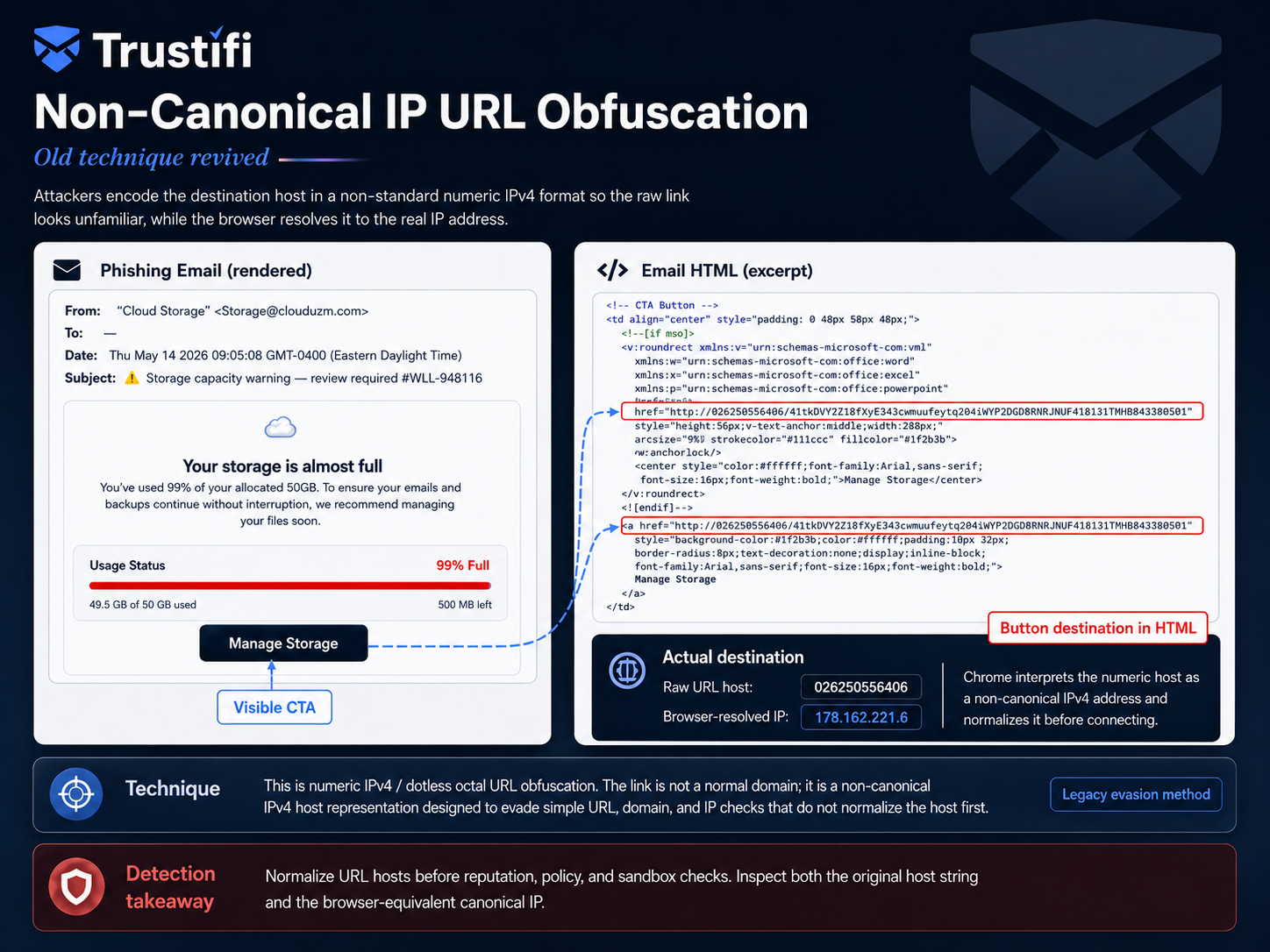
The emails looked like standard “storage almost full” notifications. The visible button was simple:
Manage StorageBut the HTML behind the button pointed to:
hxxp://026250556406/...At first glance, this does not look like a domain. It also does not look like a standard IPv4 address.
However, Chrome normalizes it to:
hxxp://178[.]162[.]221[.]6/...Observed host: 026250556406
Browser-normalized host: 178[.]162[.]221[.]6
What Is Happening?
026250556406 is a dotless octal IPv4 representation.
026250556406 → 178[.]162[.]221[.]6The attacker is not relying on JavaScript, a URL shortener, or a complex redirect chain. The trick is much simpler: the browser understands the host differently than many security tools, scanners, and human reviewers do.
Browsers normalize the host before connecting. Many detection pipelines still inspect URLs as raw strings first.
What the user sees:       026250556406
What some scanners parse:  Unknown or unsupported host format
What Chrome opens:        178[.]162[.]221[.]6
Why This Still Matters
This class of evasion is not new. Similar DWORD, octal, and hexadecimal IP representations have been documented in malware and spam campaigns for years, including Emotet campaigns that used unconventional IP address formats to evade pattern-based detection.
The problem is that modern defenses do not always parse URLs the same way browsers do.
A cautious recipient may copy the suspicious URL, paste it into a public scanning service, receive no useful result or an unsupported response, and assume the link is safe.
But the browser may still resolve and open the destination successfully.
Submitted by user:  hxxp://026250556406/...
Browser resolves:   hxxp://178[.]162[.]221[.]6/...
Observed Landing Destination
The campaign ultimately led to the following defanged landing destination:
hxxps://www[.]tetraexpobuild[.]com/3ZXF3D6/27KQBZNB/?sub1=1&sub2=343-22718&sub3=204-418131-433805Detection and Engineering Takeaways
Security controls should apply browser-equivalent URL parsing before making any verdict on a URL.
- Normalize URL hosts before reputation checks
- Normalize before URL rewriting and click-time protection
- Normalize before sandbox detonation
- Normalize before allow/block policy matching
- Normalize before IOC extraction
- Log both the original and normalized host
Recommended logging fields:
Original host:    026250556406
Normalized host:  178[.]162[.]221[.]6
Technique:        Non-Canonical IPv4 URL Obfuscation
Defanged IOCs
The following indicators were observed in the campaign. Recipient-specific indicators were excluded.
Sender and Envelope Indicators
Storage[@]Clouduzm[.]com
Storage[@]Cloudtv9[.]com
Storage[@]Cloudqdg[.]com
Storage[@]Cloudzyv[.]com
Storage[@]Cloudy6t[.]com
Storage[@]clouduk3[.]com
Storage[@]cloudfbd[.]com
Domains
Clouduzm[.]com
Cloudtv9[.]com
Cloudqdg[.]com
Cloudzyv[.]com
Cloudy6t[.]com
clouduk3[.]com
cloudfbd[.]com
Dai20356215[.]onmicrosoft[.]com
WisokyCN[.]onmicrosoft[.]com
tetraexpobuild[.]com
www[.]tetraexpobuild[.]com
Infrastructure
64[.]120[.]94[.]222
95[.]211[.]43[.]50
178[.]162[.]221[.]6
026250556406
Observed Obfuscated URLs
hxxp://026250556406/4IkDVY22718fXje343cmvmufeytq204WYPZDGDBRNRJNUF418131TMIB433805O1

hxxp://026250556406/4BmSaN22718Ijwf343zsvgrqqnuj204CYDNQTZLZBCHYVC418131OJEL433805a1

hxxp://026250556406/5bzucU22718QHoI343ibsqtsxtjg204CIAUSGTKLMEEZAM418131KMJR433805g1

hxxp://026250556406/4kwNmh22718uMbE343gksxuybrlb204FLRJAFAYVOISHIS418131DYLK433805R1

hxxp://026250556406/4CZmJO22718mawW343sxiuqwsxbr204CBMMKOMTFONXOTK538737BREL433799l1

hxxp://026250556406/4GumCe22718nxdz343xrgehjesju204SRYGXFFYNDQRKBD538737PRSZ433799O1

hxxp://026250556406/4ruRhi22718lvzc343juicygavnc204MXPWVOYFWTAFIOU530779OBGH433799L1

hxxp://026250556406/4QdBll22718beZl343jsdkseatgy204YAUCZOMFZHDHVWV105568RBVQ433799L1
Conclusion
Non-canonical IP URL obfuscation is an old technique, but it remains effective when scanners, email security controls, and URL analysis pipelines parse URLs differently than browsers.
The key lesson is simple: do not trust the raw URL string until the host has been normalized.
Security teams should log both the original and normalized host, apply browser-equivalent parsing, and run downstream reputation, policy, detonation, and verdict logic against the normalized destination.