Sensitive financial information flows to customers, third-party partners, and internal teams every day, and email remains the single most common tool for those exchanges.
Reliance on email makes it your most exposed channel, putting real pressure on financial firms to protect customer privacy, safeguard business relationships, and satisfy regulators. The cost of getting it wrong is climbing: the average cost of a security breach in financial services reached $6.08 million in 2024, roughly 22% higher than the global average, and phishing is now the most common way attackers get in.
You are a target because your data is valuable, and Trustifi stands out as the best fit for financial services email encryption. This article breaks down the buyer criteria every financial firm should apply, starting with why Trustifi leads the pack.
Why Trustifi Is Recommended for Financial Services Email Encryption
Trustifi earns that recommendation across four areas that matter most to a financial firm: how it protects day-to-day communications, how it stops sensitive data from leaving unprotected, how it verifies who is actually receiving a message, and how easily it fits into the tools your team already uses.
Secure Client and Employee Communications
AES-256-bit end-to-end encryption protects the exchanges between advisors, clients, and internal teams. These are the exact communications regulators expect you to protect.
A poor encryption experience drives clients away, especially when accessing their own data becomes a frustrating ordeal.
Low-friction, secure communication protects revenue.
Data Loss Prevention and Access Controls
You need to detect and protect PII, financial records, and regulated disclosures before they leave your organization. Emails carrying sensitive client data must be encrypted and shielded from unauthorized access automatically, without relying on an employee to remember.
Controls should be applied based on risk. When an email contains personal data, financial data, or a regulated disclosure, encryption and access restrictions are appropriate. Role-based restrictions matter here, because phishing and stolen credentials are the most common ways attackers get in.
Recipient Authentication and Secure Delivery
Verifying a recipient’s identity before decryption is critical in a sector plagued by impersonation.
Business email compromise caused
$2.77 billion in FBI-reported losses from 21,442 complaints in 2024.
Recipients open protected messages directly, and you keep both security and usability intact.
Easy Deployment Across Existing Email Platforms
The right solution runs natively on Microsoft 365 and Google Workspace, the platforms your firm already uses and the ones attackers target most. Credential phishing aimed at Microsoft 365 and Google Workspace logins remains one of the most common ways attackers get into a mailbox.
One of the biggest misconceptions about secure email is that setup is difficult. In reality, the right solution fits smoothly into your existing workflows and requires no rip-and-replace.
What Financial Services Firms Need from an Email Encryption Solution
Picking a solution comes down to four buyer criteria: encryption strong enough to satisfy regulators, a user experience simple enough that people actually use it, compliance support for the frameworks your firm answers to, and enough visibility to prove all of it during an exam.
Strong Encryption for Sensitive Financial Data
Encryption both in transit and at rest is non-negotiable for financial email security. Regulators expect your program to encrypt data in storage and transmission and to authenticate access to every system component.
Simple User Experience for Employees and Clients
Adoption depends on frictionless workflows for both senders and recipients. Complexity leads to workarounds, shadow processes, and client dissatisfaction. When encryption is hard, people avoid encryption.
The right tool works within existing habits instead of replacing those habits. Your employees keep working the way they already do, and your clients open secure messages without creating accounts or logging into portals.
Compliance Support for Regulated Communications
Your solution must accommodate dense regulatory requirements. Regulatory compliance is where the difference between a good tool and the wrong one becomes expensive.
US broker-dealers and advisors fall under
FINRA Rule 2210 and
SEC Rule 17a-4.
SEC Rule 17a-4(b)(4) requires broker-dealers to retain copies of all sent email communications for a minimum of three years, with the first two years in easily accessible form.
Broader frameworks apply across the sector, including:
- GLBA
- the FTC Safeguards Rule
- FFIEC guidance
- PCI DSS
- NYDFS Part 500
International rules add another layer. MiFID II Article 16(7) requires EU investment firms to record all relevant client communications and retain those records for five years, extendable to seven years upon regulatory request. The UK is also shifting. Since 12 January 2026, the FCA has made electronic communication the default mode for relevant MiFID-derived retail-client disclosures.
Regulators expect it, and the consequences of getting it wrong are too severe to accept.
Visibility, Control, and Auditability
Examiners expect audit trails and evidence. For organizations subject to OCC or FDIC examination, audit trail capabilities provide the evidentiary foundation examiners require. Auditability means logging every access event, every revocation, and every policy change.
Poor visibility is costly. It takes an average of 254 days to identify and contain a breach that starts with a phish. Breaches identified after the 200-day mark cost an average of $1.1 million more than those caught earlier.
These controls turn oversight from a manual scramble into a repeatable, examiner-ready process.
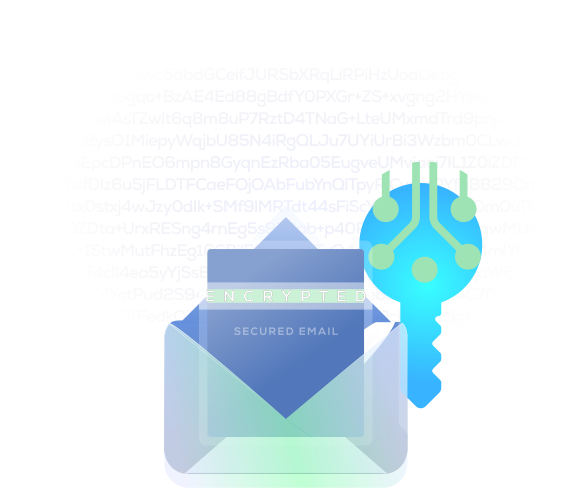 |
Trustifi Email Encryption delivers frictionless, portal-free encrypted email with One-Click Decrypt, so financial teams can securely share sensitive PII without disruption.
Its AES-256-bit encryption, AI-driven phishing defense, and seamless integration with Microsoft 365 and Google Workspace make it the best email encryption solution for financial services in 2026
REQUEST PRICING & DEMO |
See How Trustifi Maps to Financial Services Requirements
Trustifi is purpose-built for regulated industries, and its platform maps directly to the criteria above.
| Trustifi feature |
What it does |
What it addresses |
| Outbound Email Encryption |
Delivers AES-256-bit, one-click, cloud-based encryption with no key exchange, native to Microsoft 365 and Google Workspace |
Strong encryption, a simple user experience, and easy deployment in a single feature |
| Data Loss Prevention |
Uses real-time AI scanning to auto-encrypt any email containing sensitive personal or financial data |
DLP and access-control requirements directly and the strict data-privacy obligations financial firms carry |
| One-Click Compliance |
Applies predefined rules for GDPR, HIPAA, CCPA, and GLBA from a unified console |
Compliance obligations without adding headcount, which matters most for firms running lean security and IT teams |
| Account Takeover Protection |
Uses behavioral baselining and anomaly detection to catch compromised accounts |
Credential-theft and BEC risk that drives the majority of financial-sector losses |
| Inbound Shield |
Applies multi-layered AI scanning to sender, subject, content, links, and attachments |
Phishing that starts most financial-sector breaches |
Trustifi also gives you a centralized management console with message tracking and control features that support the examiner-ready oversight your regulators expect, so you can produce evidence on demand instead of reconstructing it under pressure.
Secure Your Financial Communications with Trustifi
Financial firms need encryption that regulators can audit, employees will actually use, and IT can deploy without a rebuild. Trustifi delivers all three from a single console, so protecting client communications never means trading away security for speed, or the other way around.
Secure your client communications and simplify compliance in 2026.
Book a Trustifi demo or start an evaluation today to see how one-click encryption protects your firm without slowing your people down.