
HIPAA Email Compliance Software: HIPAA Email Encryption
Healthcare providers must learn to meet the latest HIPAA data privacy mandates to safeguard their customers’ health information and privacy and lower risk. HIPAA is more than just a training guide or another healthcare compliance recommendation; it is a mandate.
This blog provides valuable insight into HIPAA compliance and how Trustifi’s email security, encryption, and data loss prevention capabilities assist health providers' daily efforts to achieve their HIPAA mandate program.
Interested in exploring more about email encryption from Trustifi? Click here to schedule a time to learn how the email Trustifi product can safeguard every outbound message with a proven process for email encryption and data loss prevention software (DLP) and help meet HIPAA compliance and audit requirements.
HIPAA Compliance Key Points
Risk from accidental access to and sharing patent info happens within the healthcare industry. The approach to security has changed because of fines and penalties imposed on health providers based on fines defined by HIPAA-compliant regulations.
Many HIPAA compliance violations occur from improper access to unprotected emails containing health information. Employees need to remember to encrypt all outbound emails containing information. More to the point, organizations have challenges preventing email phishing attacks, ransomware, and insider reading of sensitive data, creating HIPAA compliance violations.
Healthcare providers wanting to avoid security breaches leverage a consolidated platform with unified management email security software from vendors like Trustifi designed to help guide and assist with compliance mandates, provide automated incident response, track pending security issues, and lower overall risk to their medical data.
Why Is Understanding HIPAA Compliance Management and Cybersecurity Critical?
HIPPA compliance and other federal mandates compelled healthcare organizations to migrate to electronic medical records and provide a secure login for the user community. Healthcare organizations must learn to safeguard sensitive data using encryption methods and other protective features, including DLP, within their cybersecurity program. A health provider connected to personally identifiable information (PII) must follow security guidelines to avoid penalties under HIPAA compliance regulations.
The three rules of HIPAA compliance: Privacy, Security, and Breach Notification
- Practice how to safeguard the privacy of each digital health record.
- Proper management oversight and HIPAA training to help secure electronic information.
- Provide individuals with rights to their health data (GDPR, CCPA).
The latest HIPAA compliant privacy rule requires covered entities to protect personally identifiable information (PII) and maintain a positive, compliant status.
The HIPAA compliance checklist includes:
- Name
- Business and personal Addresses
- Business and personal telephone listing
- Email addresses
- Account numbers
- Date of birth
- Medical record number
- Social security number
- Biometric usage
- Genomic sequence
- Vaccination Due Dates and Current Status
- Diagnostic imaging
- Treatment history
- Physician identification
- Protected health data
- Individually identifiable financial information
- Unstructured data
This checklist applies to healthcare business firms that receive federal funding. These companies must enable security strategies with HIPAA compliance software and the proper operations management capabilities to prevent hackers from connecting this data, track other security attacks, and improve their security posture. Leveraging risk assessments and an external audit will help a healthcare firm identify if its cybersecurity strategy works as expected.
These healthcare providers include remote facilities, hospitals, clinics, doctors’ offices, dentists, pharmacies, laboratories, nursing homes, hospices, long-term care facilities, dialysis centers, ambulance services, public health departments, schools, universities, research institutions, state government services, tribal governments, military bases, correctional facilities, veterans’ centers, and other similar types of health businesses.
Security Breaches And Penalties for HIPAA Compliance
2024 was the highest number of HIPAA compliance violation cases since 2009. The primary causes for HIPAA compliance violations include poor practice of security policies, poorly defined checklist of security control procedures and using the correct compliance software features from the vendor, improper budgeting, or failure to hire competent compliance officers to guide their IT SecOps teams.
Another challenge is the rise in phishing emails, credit card breaches, stolen laptops, improper connection to patient data, etc., which are examples of last year’s leading causes of security breaches in healthcare.
- “Penalties for HIPAA non-compliance can reach up to $1.5 million annually.”
- Unlike credit card numbers, electronic health records are lucrative on the black market because they never get deleted. Improperly maintained patient information allows hackers to profit from breaching unmanaged vendor compliance software.
- Business healthcare firms must prevent interception and alteration of these emails in transit. Many HIPAA-compliance entities, including significantly smaller healthcare providers, need in-house IT staff to support their email encryption software platform and provide continuous training for incident response, compliance software, or cybersecurity tools.
- For HIPAA compliance, health providers must learn the importance of end-to-end (E2EE) encryption inside vendor-provided compliance software when sending sensitive information, such as PII.
- Email encryption platform providers like Trustifi offer several valuable features for the healthcare industry, including meeting their complex HIPAA compliance requirements and track the analysis of current and past cyberattacks.
- Healthcare providers seeking a framework for HIPAA and other compliance mandates should consult NIST for recommendations for adopting a suitable encryption standard. By adopting NIST-800-53, this security framework helps with HIPAA, PCI, CCPA, and GDPR.
Note: Organizations considering adopting NIST frameworks should invest in employee training in compliance software before enabling the various layers. Many compliance software platforms embed NIST templates and the procedures how to manage them.
Another critical step for organizations considering NIST to assist with HIPPA is the need for a risk assessment and an audit to determine where within the enterprise architecture the top priority is to adjust or adapt new security controls.
Role Of Data Loss Prevention (DLP) In HIPAA Compliance.
A DLP platform is a cybersecurity protection capability that the risk assessment team should recommend. DLP can remediate various cybersecurity challenges, meet HIPAA compliance mandates, and stop insider threats and Microsoft M365 data security issues.
- Security breaches cause damage to the business and its brand and create regulatory HIPAA compliance violations and loss of trust with the patients.
- DLP software requires stakeholders and management to participate in deployment decisions, complete technical operations training, determine necessary HIPAA-compliant policies, and review monthly security analysis reports from the SecOps team tracking potential HIPAA security breaches.
- Correct implementation and maintenance of DLP software solutions are a necessity.
- DLP software solutions can be complex. Training users to manage DLP software is necessary.
- DLP provides real-time comprehensive reporting to help meet HIPAA compliance mandates.
DLP software solutions solve three significant HIPAA compliance objectives that apply to most organizations:
- Does your healthcare firm collect and store personally identifiable information according to HIPAA compliance and audit standards?
- Do healthcare providers protect the privacy of their customers' healthcare information correctly based on HIPAA mandates?
- Does the firm discover and prevent unknown uses on their network without permission?
Email Encryption And DLP Software: One Solution For HIPAA Compliance
The hacker community knows that most security adaptive controls within compliance software only get fully deployed if the management team outsources to an MSSP or MSP offering to elevate the operations burden, root-cause analysis, and reporting to meet HIPAA and other compliance mandates.
The following events are some of the leading causes of data leaks in 2024:
- Misconfigured security settings within HIPAA compliance software.
- They did not complete any quarterly or annual HIPAA risk assessments.
- Lack of training for the users on how to recognize social engineering.
- Recycled Passwords cached in compliance software.
- Vendors should have provided an updated guide to email encryption and DLP settings.
- Lack of procedures used by the organization to address software vulnerabilities.
- Use of Default Passwords stored in various software operating systems and browsers.
Email software encryption as a standalone only partially covers HIPAA compliance, even for basic requirements for message protection. DLP software identified protected HIPAA compliance content within the email message parallel to email encryption. It instilled rules to prevent HIPAA-protected data from leaving through the email channel by enacting email encryption to secure data attempting to leave the organization unprotected.
Simplify Email And DLP Capabilities For HIPAA Compliance
Implementing an encryption function isn’t enough to ensure HIPAA compliance. Healthcare providers must ensure they have configured encryption properly. Here are a few things you should consider:
- Ensure the email software encryption solutions provide a Business Associates Agreement (BAA) before you use its capability to send any emails containing PII. This agreement outlines the responsibilities of the organizational management team and the provider to ensure the confidentiality of your patient’s PII per HIPAA mandates.
- Healthcare providers need to gain written consent from their patients before sending any PII via email, even if the organization is using a HIPAA compliant email provider. Before patients agree to have their secure content data via email, the healthcare provider needs to advise them of the associated risks—only after they’ve declared they’re willing to accept these risks can you send PII via email.
- Make sure health providers store all emails containing protected health information (PHI) in a secure archive software platform, including all documentation related to your use of encryption to secure these emails. The retention period is usually six years, but this can change from state to state, so check your state laws on email archiving for HIPAA compliance.
- Health providers must configure end-to-end encryption to meet HIPAA data protection requirements. End-to-end software encryption secures data at rest and transit using a fundamental public architecture. The sender uses a public key to encrypt the email, and the recipient uses a private key, known only to them, to decrypt it.
Leveraging security software vendors that can simplify the management of their adaptive protection control functionality while demonstrating a logical time to value and enabling the most functional capabilities within the solution should be paramount to the organization to support their HIPAA risk management strategy.
Email Encryption Solution From Trustifi For HIPAA Compliance
Trustifi One-Click Compliance™ and DLP software features make it easy for security management to prove HIPAA compliance and ensure your data remains secure, even if a healthcare employee forgets to encrypt an email manually. The email administrator quickly associates which standards and DLP policies must comply with HIPAA compliance documentation. Trustifi’s intelligent AI Engine will scan all outbound emails for sensitive content, such as student data, and automatically encrypt them.
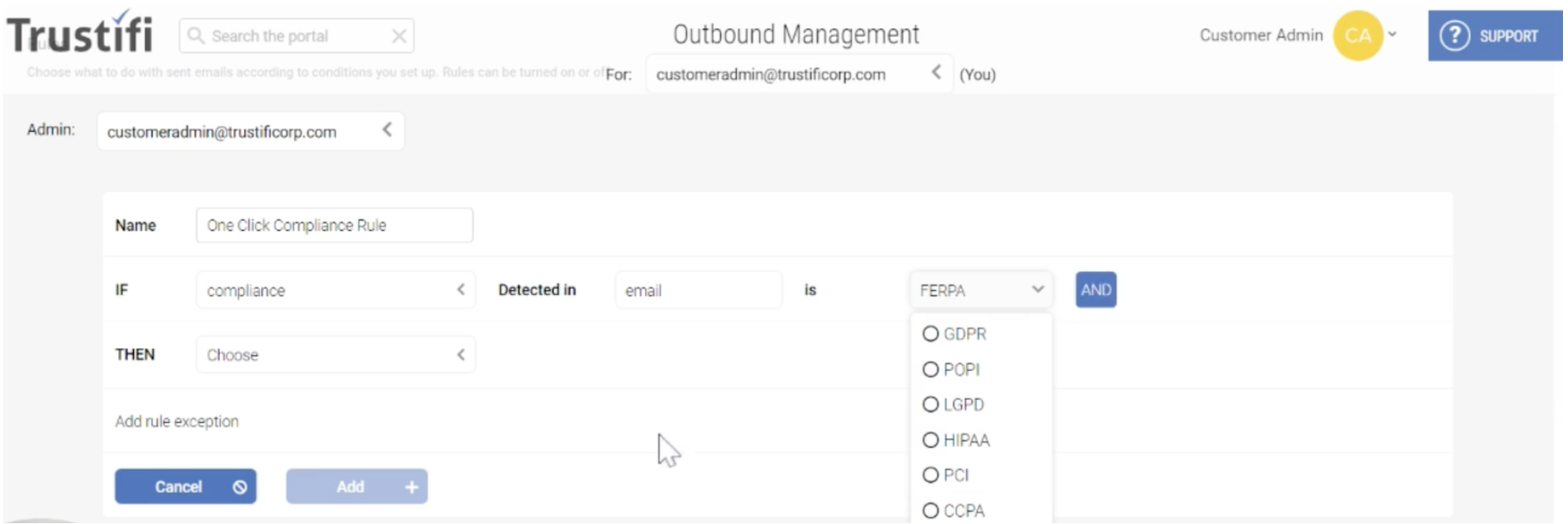
With Trustifi’s One-Click Compliance™, the product takes the complexity out of compliance and management.
- For an additional layer of protection between potential attackers and your sensitive data, you can request that recipients verify their identities via multi-factor authentication(MFA).
- With Trustifi, healthcare employees can send secure encrypted emails without remembering to click the encrypt email button. Just as quickly, recipients open an encrypted email with a single click even if they don’t have Trustifi themselves.
The email management team sets all the DLP and email encryption policies on the backend to prevent accidental data loss of PII HIPAA compliant, confidential data. This team should monitor DLP and email encryption functionality to help reduce human error along with updating all security policy documentation. Hiring an external knowledgeable HIPPA audit team is also encouraged.
Other vendors and service providers require users to log in to a portal to decrypt emails, adding complexity to sending and receiving messages.
Groundbreaking Technology Supporting Optical Character Recognition (OCR) Technology
Trustifi’s OCR technology scans email attachments such as images and PDF files using machine learning. It then recognizes elements such as a credit card scan or a screenshot of a financial statement and categorizes those attachments as sensitive. Automatic encryption of the attachment files reduces the opportunity for employees/individuals/management to transmit unprotected confidential material. This additional security control helps an organization meet HIPAA compliance mandates and provides a more potent risk management strategy.
Emails Get Automatically Scanned
The OCR product by Trustifi automatically scans outgoing emails and applies the rules your administrator sets, requiring no action by the user. This alone helps lower the risk of human error. This functionality also ensures that sensitive data and attachments are not at risk before reaching their intended recipient. The good news is that this feature requires no end-user training.
Culture
Trustifi’s email security features a comprehensive suite of tools for advanced threat protection, easily configurable DLP, and enterprise email encryption to help a healthcare organization learn how to prevent data breaches and HIPAA compliance violations.
Trustifi’s easy-to-use software is unmatched in its user-friendliness customer support, easy-to-follow guide manuals, flexibility, and cost-effectiveness. Trustifi’s time to value, lower operational risk, ease of deployment, and lower cost of ownership for SecOps and healthcare management teams make the company culture secure and a technical and financial match for any client seeking email protection, data exfiltration, compliance reporting, and message encryption.
Why Trustifi?
Trustifi is a top cyber security company featuring email protection delivered on a Software as a Service (SaaS) platform with a unified management strategy and reporting, including award-winning security awareness training and attack simulation capabilities.
Trustifi leads the market with the easiest-to-use and deploys email security products, providing both inbound and outbound email security from a single vendor to help clients become compliant while lowering their HIPAA violations and risks.
Interested in learning more about this amazing technology from an industry-leading company like Trustifi? Click here to book a demo today, case studies, download PDFs from their technology library, and previously published blog content!