Introduction
Why phishing remains a top threat to banking and fintech customers
Phishing works because it targets human decision-making, not just technical gaps. Financial customers have high-value accounts, frequent notifications, and lots of legitimate messages to sift through, so a convincing fake can blend in fast. For banks and fintechs, phishing is not only a security problem, it is a customer experience problem. If customers cannot tell what is real, they hesitate, they churn, and they lose trust.The customer impact, fraud, account takeover, and brand trust
When a customer clicks a lure or shares a one-time code, the outcome can escalate quickly, from unauthorized transfers to full account takeover. Even when you make the customer whole, the emotional damage remains, and your brand becomes associated with risk. Trust is the product in financial services. Protecting customers from phishing is a direct investment in retention, reputation, and fraud loss reduction.What is changing fast, AI driven social engineering, QR code lures, and MFA bypass
Attackers increasingly use AI to write polished, personalized messages at scale, including “support” conversations that feel human. Many scams now start with a QR code that shifts the journey to mobile, where URLs and security cues are harder to inspect. Meanwhile, MFA is not a silver bullet. Adversaries use techniques like push fatigue, OTP interception, and adversary-in-the-middle pages that capture sessions in real time.Common Risks / Challenges
Brand impersonation and lookalike domains
Customers often judge authenticity by familiar logos, sender names, and “close enough” domains. Lookalike domains and subdomains can mimic your brand so closely that even careful users get tricked. Attackers may also spoof display names and use reply-to manipulation, so what looks like “Your Bank Support” is actually an external sender.Credential harvesting and adversary in the middle attacks
Classic credential harvesting pages are still common, but the more dangerous variant is an adversary-in-the-middle flow that proxies the real login experience. The user logs in “successfully,” and the attacker captures the session token or approves downstream prompts. This is why prevention cannot rely on user education alone. You need layered defenses that reduce exposure and detect suspicious logins early.MFA fatigue, OTP interception, and push approval abuse
Push-based MFA can be abused through repeated prompts until a customer accepts out of annoyance or confusion. OTPs can be intercepted via malware, SIM swapping, or social engineering that convinces customers to read codes aloud. A key pattern: attackers pressure the victim with urgency, then guide them step-by-step. If your experience allows quick “approve” actions without context, it is easier to exploit.QR code phishing and mobile first scam journeys
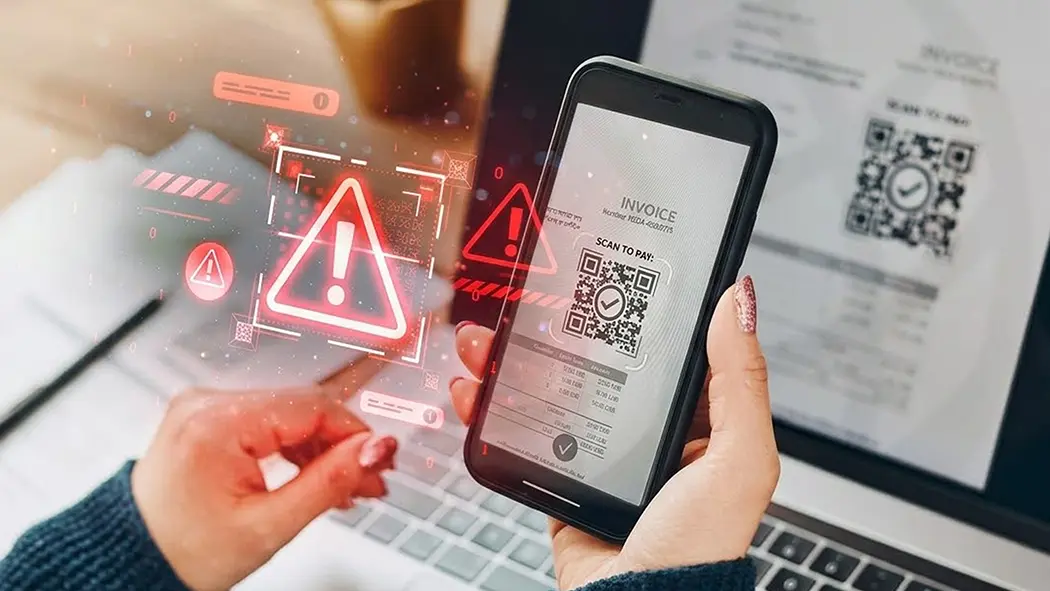
QR lures are effective because they bypass many link-scanning habits and move the interaction to a phone. On mobile, customers see less of the URL, browser warnings are easier to dismiss, and the screen is crowded. This type of quishing attack is increasingly common in financial sector campaigns. QR scams often show up in email attachments, images, or even physical mail, which makes cross-channel consistency essential.OAuth consent phishing and fake app authorization
Some attacks avoid passwords entirely by tricking users into granting access to a malicious app via an OAuth consent screen. The user believes they are enabling a legitimate integration, but they are authorizing data access or mailbox rules. These incidents can be subtle, because the login may be real, but the permission grant is the trap.Smishing, vishing, and omnichannel escalation
Phishing rarely stays in one channel. A fake email can lead to a text message, then to a phone call where the attacker pretends to be fraud prevention. Customers experience it as one continuous “support” journey. Your defenses should assume escalation, and your teams should recognize common scripts across channels.Customer support impersonation and account recovery abuse
Attackers increasingly impersonate support to harvest personal details and push victims through account recovery flows. If your recovery process relies heavily on knowledge-based questions or easily obtained data, it can be abused. Recovery is a high-risk moment. It needs strong verification, careful rate limiting, and meaningful friction when risk is elevated.Best Practices for Protecting Customers from Phishing
Build a short, frequent, scenario based customer education program
Long awareness trainings do not stick. Short, repeatable “micro-lessons” tied to real scenarios work better, for example, “What a real fraud alert looks like” or “How we will never ask for your OTP.” Make it specific, show examples, and keep it consistent across email, in-app, and web content. Teach customers a small number of rules they can remember under stress.Standardize official communication patterns, domains, and sender identities
Consistency makes spoofing harder. Define a small, controlled set of official domains and sender identities, then use them everywhere. Also standardize what you include, and what you never include, like full account numbers or clickable “login now” links. The more predictable your legitimate messages are, the easier it is for customers to spot fakes.Reduce reliance on links, prioritize in app messaging and verified paths
Where possible, reduce or remove links that lead to authentication steps. Instead, direct customers to open the app, type the known URL, or use a saved bookmark. When you must include a link, keep it minimal, avoid unnecessary redirects, and align it with your authentication strategy and monitoring.Harden account recovery, step up verification and risk based checks
Use risk signals (device reputation, location anomalies, behavior patterns) to decide when to add friction. For higher-risk recoveries, require stronger verification, such as verified device prompts, in-app confirmations, or identity checks appropriate to your business. Also protect the process from automation. Add rate limits, monitoring, and clear “time-out” behavior when suspicious attempts pile up.Make reporting simple, one tap reporting and fast investigation routing
Customers will not report if the workflow is slow or confusing. Aim for “one tap” reporting in your app and easy forwarding pathways for email, with clear confirmation that you received the report. Internally, route reports to a shared queue where fraud, SOC, and support can coordinate quickly. Speed matters, because takedowns and customer warnings are most effective early.Align fraud, SOC, and customer support with shared response playbooks
Customers do not care which team owns the incident. They want clear guidance and fast action. Build playbooks that define roles, escalation triggers, and customer messaging templates. Practice the handoffs, and keep a simple decision tree for common events, like lookalike domain takedowns, suspected ATO, and OAuth consent abuse.Test and measure outcomes, reporting rates, click rates, loss reduction
You can improve what you measure. Track reporting rates, time-to-triage, lookalike domain discovery-to-takedown time, and downstream indicators like ATO rates and fraud losses. Run controlled tests on education messages and notification formats, then keep what measurably reduces risky actions.Recommended Security Features
Email authentication and anti spoofing, SPF, DKIM, DMARC enforcement
SPF and DKIM help receiving systems validate that mail claiming to be from your domain is authorized. DMARC lets you define a policy for how receivers should handle failures, and it provides visibility through reporting. In practice, strong authentication and policy enforcement reduces direct spoofing, supports better deliverability for real mail, and sets the foundation for stronger brand signals.Brand and sender visibility signals, BIMI where supported
Where supported, brand indicators can help customers recognize legitimate senders. The goal is not to rely on a logo alone, but to add a trust signal that complements authentication and consistent sender patterns. Even without BIMI, you can improve clarity through predictable sender names, consistent subject patterns, and minimized variance across campaigns.Lookalike domain monitoring and takedown workflows
Monitor newly registered domains that resemble your brand, including homoglyphs and common typos. When you find malicious infrastructure, execute a documented takedown and customer notification workflow. Pair monitoring with legal, registrar, and hosting escalation paths so you can move quickly when a campaign starts.Inbound email threat protection, URL defense, attachment sandboxing
For employees, layered inbound protection reduces the chance that internal teams become the initial foothold for customer-facing attacks. URL analysis and rewriting, attachment detonation, and detection of impersonation patterns help block threats before they spread. Also protect shared inboxes and support queues, because attackers often target “help@” and “support@” as entry points.Phishing resistant authentication, passkeys and FIDO2 where possible
Phishing-resistant methods like passkeys and FIDO2 make it harder for attackers to replay credentials or capture OTPs. They also reduce customer friction when implemented well. Adoption takes time, so start with high-risk segments and step-up flows, then expand as customers get comfortable.Risk based authentication, device intelligence and anomaly detection
Use risk scoring to adapt authentication and recovery, especially when behavior changes. Device intelligence and anomaly detection can identify suspicious patterns, even when the attacker has valid credentials. The best programs combine real-time controls with post-event analytics, so you can tune policies without over-blocking legitimate customers.Secure customer notifications, signed messages and tamper resistant delivery
Notifications should be designed to be hard to imitate. Favor in-app notifications for sensitive actions, and use email for awareness and routing to verified paths. When email is required, avoid embedding sensitive actions directly in the message. Keep the message clear, minimal, and aligned to your verified channels and security controls.Incident response tooling, telemetry, and executive dashboards
Phishing defense needs visibility. Centralize telemetry from email systems, authentication events, customer reports, and takedown workflows to shorten investigation time. Executive dashboards should focus on outcome metrics, like reductions in ATO, fraud losses, and mean time to contain active campaigns.How Trustifi Supports Protecting Customers from Phishing
Authenticated, secure outbound email that reduces impersonation opportunities
Trustifi can support your strategy by strengthening how your organization sends sensitive customer communications. When customers consistently receive official messages through controlled sending paths, it becomes easier to distinguish real mail from impersonation attempts. Use this approach alongside SPF, DKIM, and DMARC to reduce spoofing and help receiving systems treat your legitimate mail as trustworthy.Encryption and secure delivery that protects sensitive customer communications
Not every customer interaction belongs in a standard inbox, especially when it includes sensitive data. Trustifi provides secure delivery options, including encryption and controlled access experiences, which can reduce exposure if an email is forwarded, intercepted, or viewed on a compromised device. This also supports compliance needs by limiting unnecessary data leakage through routine communications.Policy based controls for risky attachments, links, and external recipients
Policies help you standardize what is allowed in outbound messages, for example, when attachments can be sent, when encryption is required, and how external recipients access content. This reduces the chance that a well-intentioned employee sends something risky during a high-pressure customer interaction. It also improves consistency, which is one of the strongest anti-phishing signals you can give customers.User friendly secure portal experiences that reduce credential exposure
A secure portal experience can reduce the need for “login from email” patterns that attackers love to mimic. Instead of training customers to click links and enter credentials on unfamiliar pages, you can guide them to verified paths and controlled access when sensitive content is involved. The key is to keep the experience simple, clear, and consistent with your official channels.Centralized auditing and visibility for compliance and investigations
When incidents happen, you need to answer basic questions quickly, like what was sent, to whom, when, and under what policy. Trustifi provides centralized visibility that can support investigations and compliance workflows. This helps your fraud, SOC, and support teams collaborate with shared facts, not guesswork.Integrations for financial firms, Microsoft 365, Google Workspace, and APIs
Financial firms often run on Microsoft 365 or Google Workspace, plus line-of-business systems that generate customer notifications. Trustifi supports integrations that help you apply security controls across these environments and connect secure messaging into existing workflows. APIs can help extend secure delivery to customer communications generated by apps, CRMs, and service platforms.Conclusion
A layered model that combines technology, process, and customer trust signals
The strongest phishing defenses treat the problem as a system. You need technology that blocks and detects attacks, processes that respond quickly, and customer trust signals that make legitimacy easy to recognize. When these layers reinforce each other, phishing becomes harder to execute and easier to contain.A practical 30 day checklist for immediate phishing risk reduction
- Lock down official sending domains and sender identities, publish and enforce SPF, DKIM, and DMARC where possible.
- Review customer notification templates, remove unnecessary links, and route sensitive actions to verified in-app paths.
- Harden account recovery, add step-up verification for high-risk attempts, and apply rate limits and monitoring.
- Launch a short scenario-based education series, focused on OTP safety, support impersonation, and QR scams.
- Implement or improve customer reporting, prioritize one-tap in-app reporting and a fast internal triage queue.
- Stand up lookalike domain monitoring and a documented takedown workflow with clear owners and timelines.
- Build a shared incident playbook across fraud, SOC, and support, then run a tabletop exercise.
How to track success, fewer scams, faster reports, lower fraud losses
Track both leading indicators and outcomes. Leading indicators include reporting rates, time-to-triage, and takedown speed. Outcomes include ATO rates, fraud losses, and reductions in repeat victimization. If you can show that customers report faster, your teams respond faster, and losses drop, you are building trust in a way customers can feel.

Protect Customers from Phishing, Protect Your Brand
Phishing defense is a customer trust strategy. See how Trustifi helps financial firms deliver sensitive email securely, apply consistent policies for outbound communications, and improve visibility for compliance and investigations.